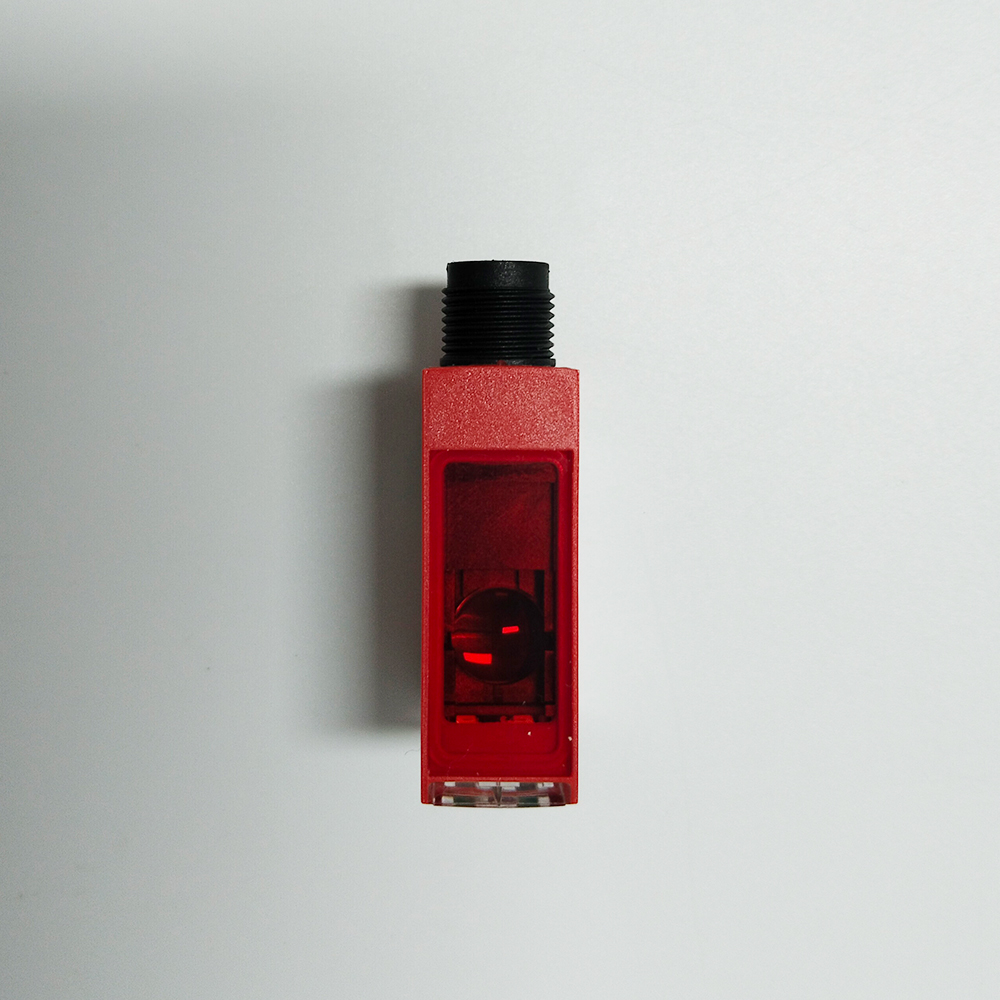
The anti-interference capability of photoelectric sensors is a critical metric for assessing their stable operation in complex electromagnetic environments and harsh working conditions. Evaluating this capability requires systematic testing and analysis across multiple dimensions. The following is a comprehensive methodology for assessment:
I. Electromagnetic Compatibility (EMC) Testing
1. Electromagnetic Susceptibility (EMS) Testing
Electrostatic Discharge (ESD) Immunity: Following IEC 61000-4-2, apply contact discharge (typically ±4kV to ±8kV) and air discharge (±8kV to ±15kV) to the sensor housing and interfaces, observing any malfunction or performance degradation.
Radiated Radio-Frequency Electromagnetic Field Immunity: Per IEC 61000-4-3, apply field strengths of 10V/m or higher in the 80MHz–6GHz frequency band to verify stability in wireless communication environments.
Electrical Fast Transient/Burst (EFT) Immunity: Simulate switching transients to test immunity at power and signal ports (typically ±1kV to ±2kV).
Surge Immunity: Per IEC 61000-4-5, simulate overvoltages caused by lightning or switching operations (line-to-line ±0.5kV to ±2kV, line-to-ground ±1kV to ±4kV).
2. Electromagnetic Interference (EMI) Testing
Assess the sensor's own interference emissions to external equipment, including conducted and radiated emission tests, ensuring it does not disturb other devices.
II. Optical Interference Resistance Assessment
1. Ambient Light Immunity
Direct High-Intensity Light Test: Use halogen or LED sources (up to 100,000 lux) to directly illuminate the sensor receiver, detecting false trigger probability.
Flickering Light Source Test: Simulate fluorescent or LED lighting flicker (typically 50Hz–10kHz) to evaluate impact on modulation/demodulation circuits.
Sunlight Simulation: Use full-spectrum sources to simulate direct sunlight, verifying reliability in outdoor applications.
2. Cross-Talk Testing
Test串扰 between adjacent sensors when mounted side-by-side.
Evaluate coexistence capability of sensors with different modulation frequencies.
III. Environmental Adaptability Testing
1. Physical Environmental Interference
Vibration and Shock: Per IEC 60068-2-6 and IEC 60068-2-27, conduct sinusoidal vibration (5Hz–500Hz, 5g–10g) and mechanical shock (30g/11ms) tests.
Thermal Cycling: Cycle between -40°C and +85°C (industrial grade) or wider ranges to inspect optical component thermal drift and electronic stability.
Humidity and Corrosion: Long-term operation at 85% RH and salt mist testing (IEC 60068-2-11) to evaluate sealing performance.
2. Contaminant Interference
Dust Testing: In controlled dust concentrations (e.g., IP6X dust-tight test), verify pollution compensation capability of optical windows.
Oil Mist/Water Fog Testing: Simulate industrial environments with cutting fluids or oil mist, assessing impact on detection range and accuracy.
Condensation Testing: Rapid temperature change conditions to inspect anti-condensation design and heating defogging functions.
IV. Electrical Interference Resistance
1. Power Quality Adaptability
Voltage Dips and Interruptions: Per IEC 61000-4-11, test hold-up time or reset characteristics during 0% to 100% voltage dips.
Voltage Fluctuation: Test performance stability within ±10% to ±20% of rated voltage.
Harmonics and Noise: Verify filter circuit effectiveness under power conditions with high-order harmonics.
2. Load and Wiring Interference
Long-Distance Transmission Testing: Verify anti-interference capability with signal cables over 100 meters, evaluating drive capability and termination matching.
Load Transient Testing: Impact of back-EMF from inductive load switching on sensors.
V. Systematic Assessment Methods
1. Malfunction Rate Statistics
Conduct long-term operation tests under standard interference conditions (e.g., MTBF verification),统计 false trigger and missed detection rates, calculating mean time between failures.
2. Performance Degradation Analysis
Establish relationship curves between interference intensity and key parameters such as detection distance, response time, and repeatability accuracy, determining performance degradation thresholds.
3. Comparative Benchmark Testing
Parallel testing of the sensor under evaluation with industry benchmark products (e.g., Omron E3Z series, Keyence PZ series) under identical conditions.
Use standardized test fixtures to ensure comparability.
VI. Field Validation and Accelerated Aging
1. Real-World Operating Condition Testing
Conduct at least 3 months of field validation in target application scenarios (e.g., welding workshops, food production lines, logistics sorting), recording failure logs.
2. Accelerated Life Testing
Shorten test cycles by increasing stress levels (temperature, voltage, vibration) to predict actual service life.
VII. Assessment Index System
It is recommended to establish a quantitative scoring system:
Class A (Excellent): Passes all test items per IEC 60947-5-2, field malfunction rate <0.01%.
Class B (Good): Meets conventional industrial environment requirements, occasional interference but self-recoverable.
Class C (Fair): Requires shielding measures, not suitable for high-interference applications.
Evaluating the anti-interference capability of photoelectric sensors is a systematic engineering task requiring combination of laboratory testing and field validation. During selection, relevant indicators should be assessed based on specific interference types in the application scenario (e.g., electromagnetic interference emphasis for welding environments, water/oil contamination emphasis for food industry) to avoid over-engineering or insufficient protection. Modern high-end photoelectric sensors typically integrate digital filtering algorithms, automatic gain control, and diagnostic functions—these soft capabilities are also important components of anti-interference capability.


